New 2026 regulations for your personalized labels
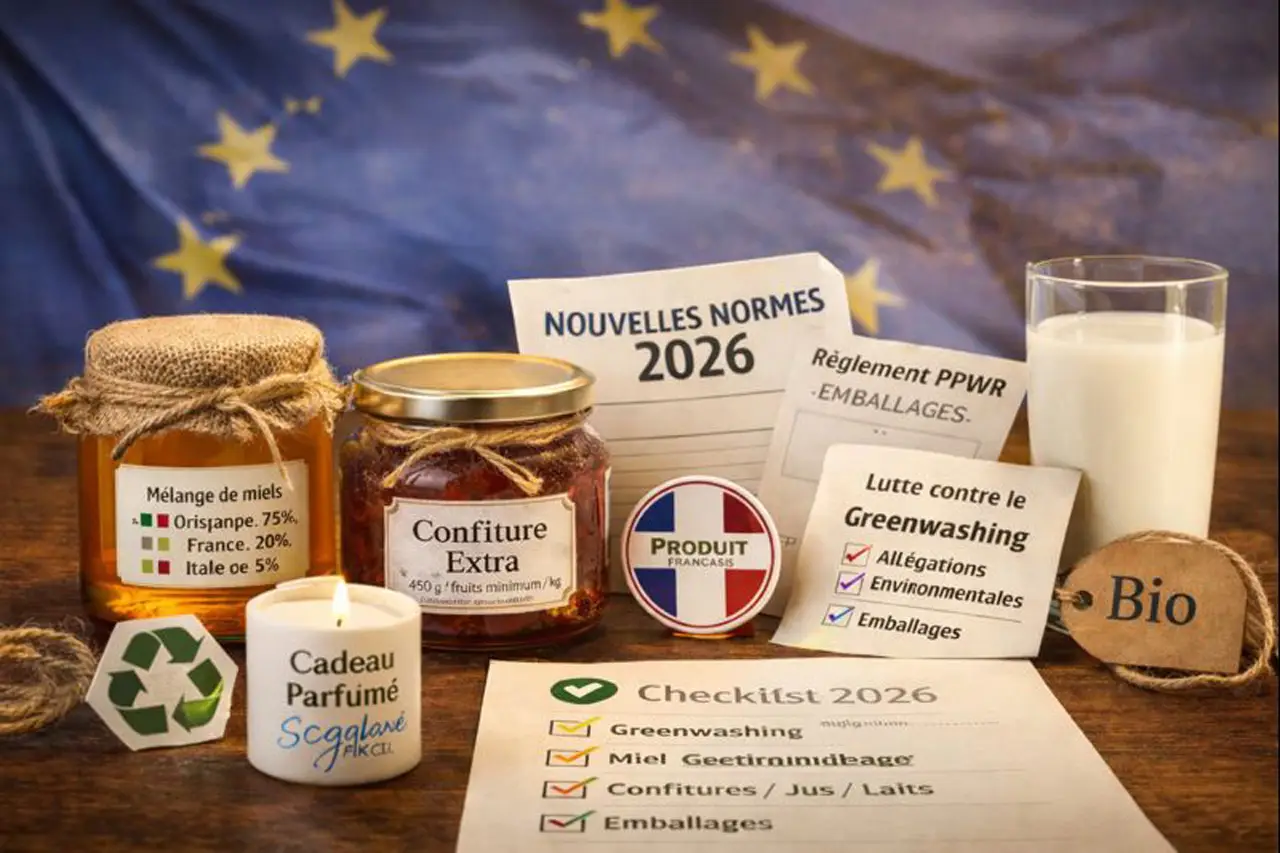
Labeling regulations 2026: what is changing in france and europe (and what you need to check)
2026 is not just another year when it comes to labeling. Between the stronger crackdown on vague environmental claims, new rules for certain food products (honey, jams, juices…), and the entry into application of a major european regulation on packaging, it is easy to lose track.
Here, we provide a clear, factual, action-oriented update — so your labels stay compliant, clean, and ready to print.
1) Anti-greenwashing: what changes from september 2026
From 27 september 2026, european rules become much stricter on environmental claims and “sustainable” labels. In practice, vague, general, or unsubstantiated promises become a risk area.
What this means for your labels
- Avoid vague wording such as “eco-friendly”, “planet-friendly”, “green”, “sustainable” if it is not defined and justifiable.
- Be careful with labels: a label must meet defined criteria and be certified by an independent third-party body, otherwise it may be considered misleading.
- Think about your icons: a “green” pictogram or a leaf + a slogan can be interpreted as an environmental claim.
Pragmatic tip: if you want to display an environmental benefit, prepare your supporting evidence (standard, certificate, audit, etc.) and keep the wording precise (e.g., material, process, scope), rather than a “general” promise.
2) Breakfast directives: new rules (honey, jams, juices, milks) from june 2026
A package of european texts changes marketing standards and labeling for several “breakfast” products. Key date: 14 june 2026.
Honey: much more transparent origin (including blends)
If your product contains honey (or if you sell honey), keep this in mind: in the case of a blend of honeys from several countries, the label must state the countries of origin and the corresponding percentage, in the main field of vision, in descending order. A 5% tolerance is provided.
Jams / jellies: higher “minimum fruit” thresholds
Definitions are changing and minimum fruit contents increase, including: jam: 350g → 450g of fruit / kg; extra jam: 450g → 500g / kg.
Fruit juices: new categories and possible wording
The texts introduce changes (including “reduced sugar” categories) and allow clearer wording about naturally occurring sugars, under conditions. If you are concerned, plan a review of product names and front-of-pack wording.
Canned milks / dehydrated milks: technical changes and product names
The texts notably open the way to certain developments (e.g., treatments allowing lactose-free dehydrated products), and adjust technical parameters/product names depending on the case. Here too: review product by product.
Important point: products placed on the market or labeled before 14 june 2026 can generally continue to be sold until stocks are exhausted (sell-off logic).
3) Packaging: the ppwr regulation applies from august 2026
The new european regulation on packaging and packaging waste (ppwr) is a structuring text. Its general application date is set for 12 august 2026.
Why does this matter for your labels?
- Because the eu is aiming for more harmonization of information useful for sorting and recyclability, with arrangements that roll out over time.
- Because many “packaging” obligations then translate into markings, material constraints, or information to display.
Key takeaway: the ppwr has an application date in 2026, but some very concrete obligations arrive via implementing acts / specific timelines.
4) France: new epr scheme for professional packaging on 1 january 2026
In france, a text creates a new important step in extended producer responsibility (epr) for packaging consumed or used by professionals, with entry into force on 1 january 2026.
This point is less “graphic” than label statements, but it impacts overall compliance: reporting, fees, traceability, organization… and it often ends up affecting packaging and labeling choices.
5) 2026 checklist (simple and useful)
Step 1 — Inventory your labels
- List your skus + photos of current packaging
- Identify all “green” statements (labels, slogans, icons, promises)
- Identify products affected by honey / jams / juices / milks
Step 2 — Anti-greenwashing update (before sept. 2026)
- Remove or reword vague claims
- Check the legitimacy of displayed labels (criteria + third-party certification)
- Centralize your evidence (certificates, audits, technical sheets, etc.)
Step 3 — Breakfast directives update (before june 2026)
- Honey: countries of origin + percentages in case of a blend
- Jams: check recipes + product names vs fruit thresholds
- Juices: check product names / categories / permitted wording
Step 4 — Packaging (ppwr)
- Put the 12 august 2026 date in your compliance plan
- Ask your packaging suppliers for their compliance roadmaps
- Plan a “sorting / recyclability / markings” review over 2026–2028
If you want, i can also propose a “label migration plan”: what to change, in what order, and how to avoid throwing away stock.
Faq
Does everything change at once in 2026?
No. There are several dates and transition periods. 2026 is a pivotal year, but part of the effects are gradual.
I sell in france only: am i affected by europe?
Yes, because many rules are european, then transposed or directly applicable. And if you ever sell abroad, this is even more true.