The right size for your online champagne label order
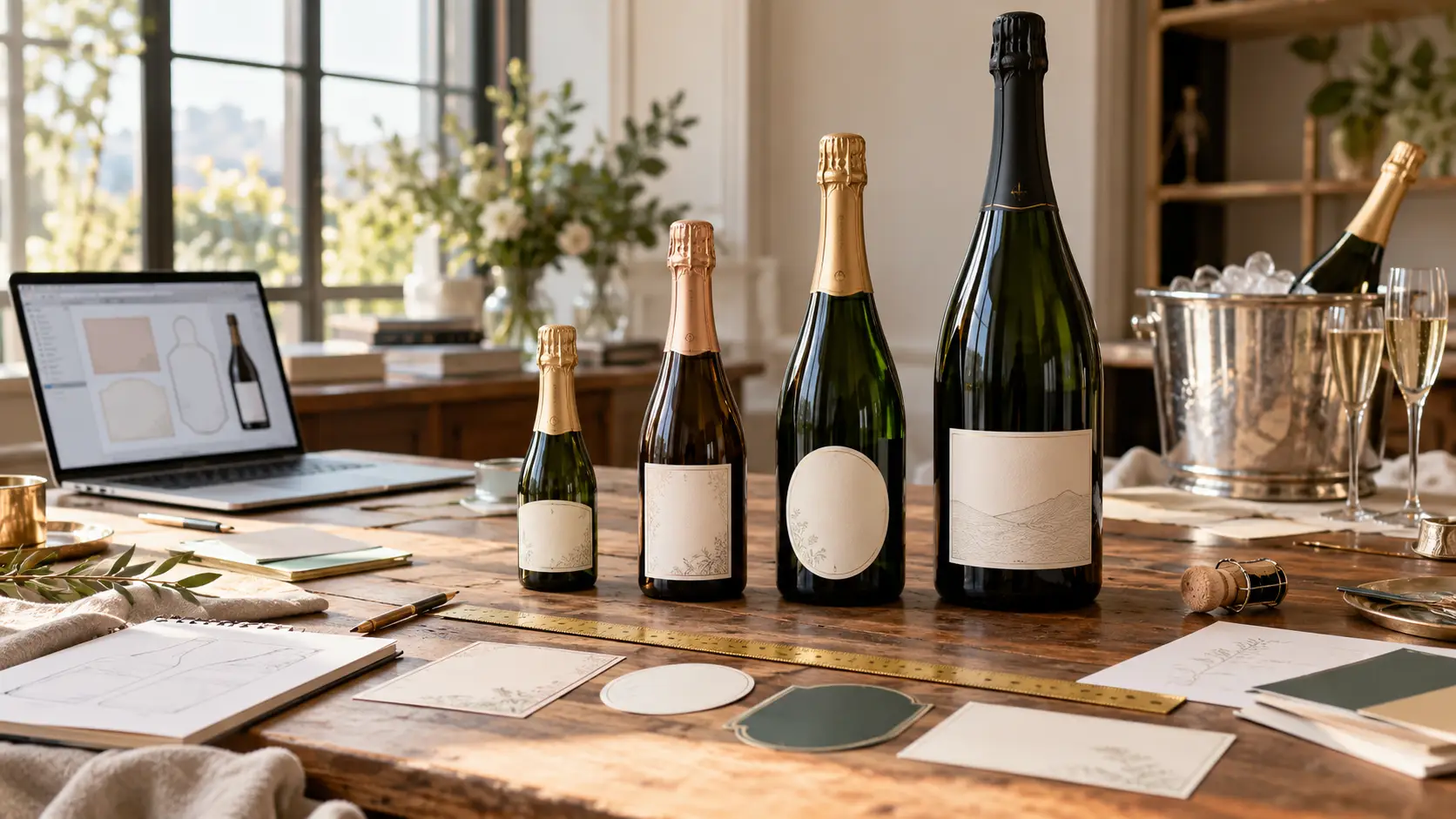
Ordering champagne labels online involves a few practical choices, each of which affects the final result. Bottle measurements, format, material, finish, design and wording come before comparing the price in euros, then checking and applying the labels once received.
Choose the champagne label format
No single size suits every bottle. The available surface area and the curvature of the glass vary from one model to another, and the actual bottle determines the constraints. The format should therefore be selected after precise measurement, based on the intended placement: front label, back label or neck.

Measure the champagne bottle
Only the regular part of the body counts. Measure its width and height without including the shoulders, contours or narrowing areas. A paper template cut to the intended dimensions can then be used as a test: placed on the champagne bottle, it shows from the front and side whether the label wrinkles or rises onto the shoulders.
A wrap-around label requires an additional calculation. Its usable length depends on the chosen application method: with a gap between the edges, edge to edge, or with an overlap. It is therefore not automatically equal to the circumference of the container body.
Adjust the dimensions to the volume
For a 75 cl bottle, two standard front-label formats serve as reference points: 120 × 70 mm and 100 × 130 mm. They should still be checked on the actual bottle, using the template described above.
Small containers have their own reference sizes: 6 × 8 cm for 20 cl and 6.5 × 8.5 cm for 37 cl, with no universal standard. By contrast, a magnum holds 1.5 litres, equivalent to two 75 cl bottles. Its shape and diameter require an appropriately sized template.
| Container | Format guide | Point to note |
| 20 cl bottle | 6 × 8 cm | Commercial landmark, not universal |
| 37 cl bottle | 6.5 × 8.5 cm | Commercial reference point, not universal |
| 75 cl bottle | 120 × 70 mm or 100 × 130 mm | To be checked on the actual bottle |
| Magnum (1.5 litres) | Custom template | Shape and diameter designed specifically for magnums |
Choose the placement and cut
Once the front label has been sized, the back label should be planned separately: 60 × 80 mm is an indicative format. The information to be included may require more space. As for the shape, a rectangle structures the layout, while round, oval or die-cut shapes allow for other compositions.
Votre Étiquette offers front, back and neck label formats, with customizable dimensions in the editor. The Label shape catalogue also includes the crest, the heart and the warranty strip. A specific shape not available in the editor can also be added.
Select a label suitable for cold temperatures
A bottle of champagne goes from the refrigerator to an ice bucket, then to the table. The label material must withstand this journey without warping or peeling off. The difference lies in the material chosen, as well as in the adhesive and surface protection.
Compare adhesive materials
Votre Étiquette offers matte, glossy, transparent and textured materials. Each is suited to a different finish and use, presented in the choice of self-adhesive label materials :
- Textured paper a tactile finish, appreciated for a premium presentation.
- Kraft a handcrafted look, with the same limitations as ordinary paper when exposed to prolonged immersion.
- PP, PE or PET films These synthetic films are generally more resistant to water and tearing than paper, depending on their formulation and finish.
- Transparent backing it allows the glass to show through; a white underlayer makes light-colored text or designs opaque and legible.
Some specially treated papers can nevertheless withstand immersion. Paper is therefore not automatically ruled out: it all depends on how it is treated and the intended use.
Check resistance to cold and water
The material alone is not enough. The durability of adhesive labels depends on the combination of the material, the adhesive, and the surface protection: a water-resistant material can peel off if its adhesive is unsuitable. On clean, dry glass, a standard permanent adhesive may be sufficient. Application to cold glass or glass exposed to condensation may require an adhesive specified for cold, damp glass.
In practice, a label that stays in place after chilling will not necessarily adhere to an already wet bottle. For repeated service in an ice bucket, test a bottle under real-life conditions and check for wrinkling, bubbles and lifting at the edges. A removable adhesive designed for temporary personalization should also be tested on the specific glass concerned.
Choose effects and protection
A matte finish reduces reflections. A glossy finish enhances them, with more vibrant colours. Hot foil stamping creates a metallic effect that differs from metallic ink or a solid yellow fill, and its fine details must remain compatible with the process. On metallic paper, printed colours may also differ from the on-screen preview.
In addition, spot varnish highlights certain areas, embossing adds texture, and lamination protects against certain scratches. These processes, commonly used to achieve a premium finish, may increase the cost and lead time. No surface protection can compensate for an unsuitable adhesive.
Create the design and check the required information
Once the material has been chosen, all that remains is the design. It must be appealing, print cleanly and comply with the bottle's regulations if it is marketed. These three requirements should be addressed in this order: the template, the file, then the mandatory information.
Customize a template for a wedding or a vintage
Votre Étiquette offers custom champagne label templates in its online editing software. Text, colors, images, logos, fonts, and graphic effects can be edited there, with a real-time preview.
A champagne label for a wedding can combine first names, the date and a design matching the event. A personalised champagne label for a birthday can include a photo, an age or a message: the editor allows you to add a personal photo directly.
For several vintages, a common background can remain the same while the name, vintage year or batch changes; each version is checked separately. A vintage champagne is made from grapes harvested in a single year, but the vintage year is not mandatory on every bottle. If no template is suitable, the AI assistant helps you create your champagne label based on your specifications.
Prepare the file for printing
An imported file must comply with technical requirements. A printer's specification requires images to be at least 300 dpi at their final size and graphic elements to be at least 600 dpi. CMYK mode and colour profiles must be confirmed with the printer.
Bleed, the margin printed beyond the trim line, is 1.6 mm or 2 to 3 mm depending on the process. A 2 mm inner safety margin keeps important elements away from the cut line. For lines, allow at least 0.25 point for dark on light. For light on dark, the minimum increases to 0.5 point.
A QR code should measure at least 10 mm, preferably 20 mm, and be tested for readability after printing. A barcode should be kept at 80% of its reference size and surrounded by a quiet zone. The proof must then match the exact final version: dimensions, die-cutting, text, colours, finishes and QR destination.
Check the commercial information
According to the Champagne Committee, the information to be checked on a bottle placed on the market includes the appellation, brand, dosage, alcoholic strength and volume. This is supplemented by the producer, batch number, allergens and, in France, the pregnancy warning. Any added decorative label must neither conceal this information nor mislead consumers about the origin.
Regulation (EU) 2021/2117 requires an ingredient list and a nutrition declaration for the wines concerned placed on the market from 8 December 2023. According to the European Commission, wines produced before that date may continue to be marketed under the previous rules until stocks are exhausted. Some of this information may be provided via a QR code, separate from commercial content, but the energy value and allergens must remain on the physical label.
Order and apply the labels you receive
Once the format, material and design have been finalized, the order is completed online. All that remains is to determine the quantity, packaging and schedule, then compare the actual price. A well-designed label is ultimately judged upon delivery and application.
Confirm options and quantity
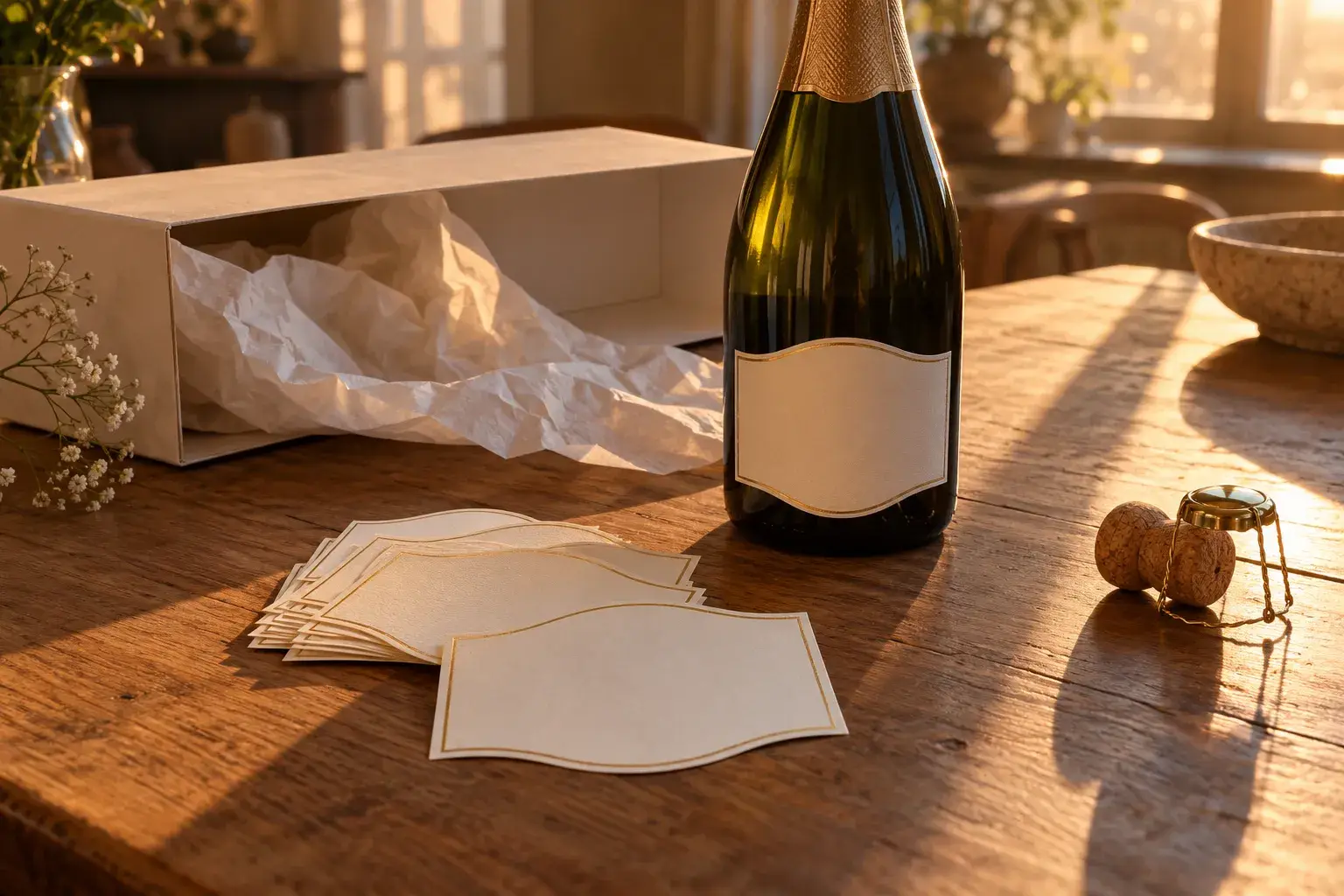
The process can follow this order: format and material, finishes and quantity, template customisation or file upload, then preview review before confirmation. Votre Étiquette accepts orders for personalised champagne labels starting from just 1 copy. Labels are supplied on sheets for manual application or on rolls; automatic application requires defining the winding direction, orientation, core, cut pitch and spacing with the machine. To estimate delivery times, distinguish between design, any proof approval, production and transport.
Compare the final price in euros
The price of an order depends on several technical parameters:
- Dimensions and shape A custom shape is not charged the same as a standard rectangle.
- Backing and adhesive A cold-resistant film or an adhesive for wet glass will affect the price.
- Finishes and printing process Foil stamping, spot varnishing or embossing require additional processes.
- Quantity and presentation : sheets or rolls, and print run volume.
Votre Étiquette applies volume-based pricing: a larger print run can reduce the unit price in euros without reducing the total price. A valid comparison uses the same specifications and quantities, then checks the total including VAT and shipping. A digital file, printed labels alone, or already-labelled personalised bottles do not correspond to the same service.
Check and apply labels
Upon delivery, check the quantity, dimensions, colours, die-cutting and visible defects before applying the entire batch. In the event of a discrepancy, compare the labels with the order form and the proof, then retain unused samples and photographs. In France, Article L221-28 of the Consumer Code excludes clearly personalised goods from the right of withdrawal, without eliminating remedies for non-compliant delivery.
Apply to clean, dry glass with no condensation. Smooth the label gradually toward the edges, then check the alignment, wrinkles, bubbles and lifted corners. Allow the recommended adhesion time before placing in a cold environment.