Custom transparent label
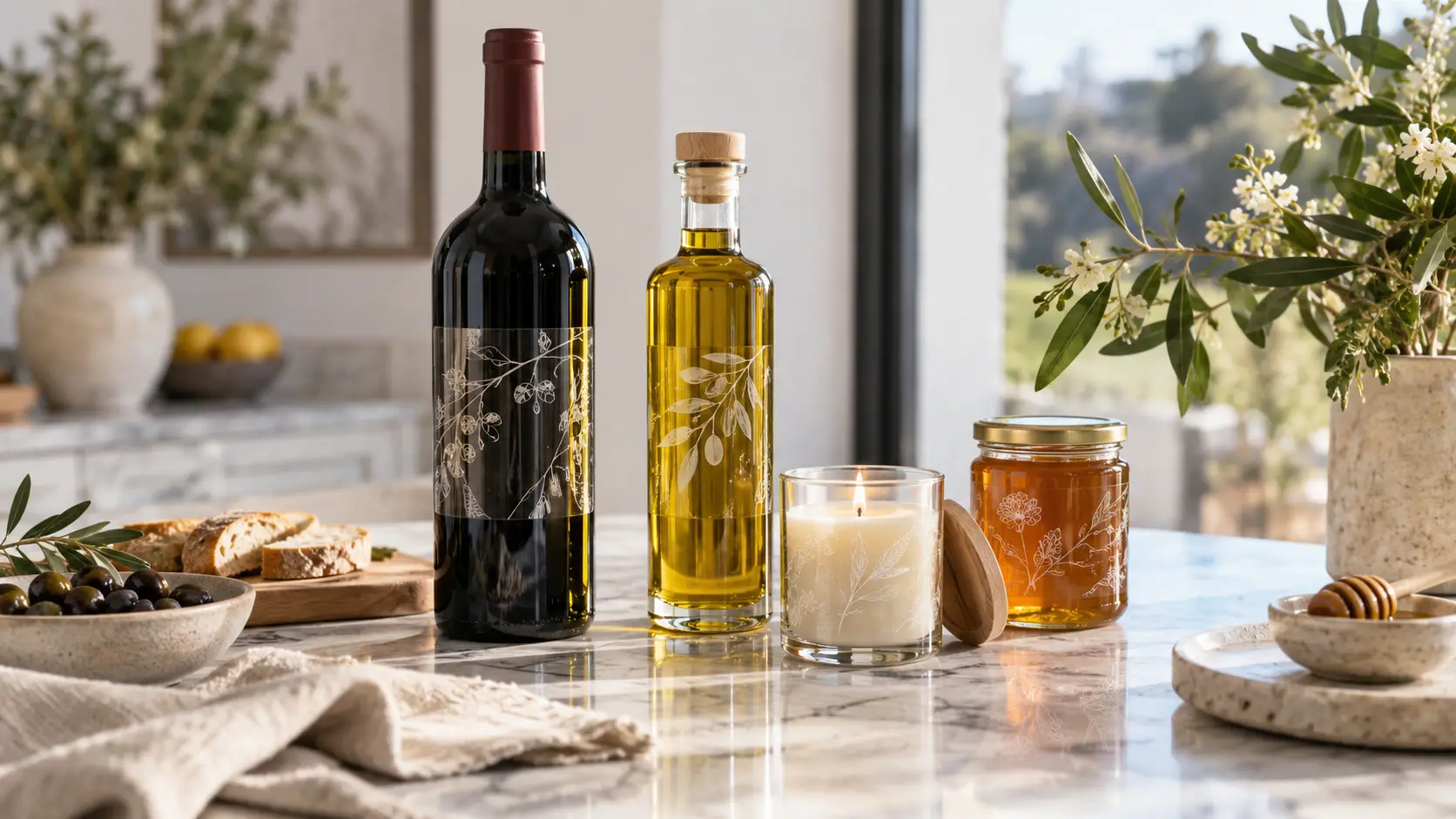
A custom label on a transparent substrate allows the glass and its contents to remain visible, provided you choose the right film, adhesive and finish. Material, durability, appearance, format, file, price and mandatory information must all be decided before ordering.
Which transparent film should you choose for a bottle or jar?
The choice begins with the material. A transparent film does not have the same flexibility or thickness depending on its composition, and these differences determine how well it adheres to a straight-sided glass, a curved bottle or a flexible jar.
What the transparent material refers to
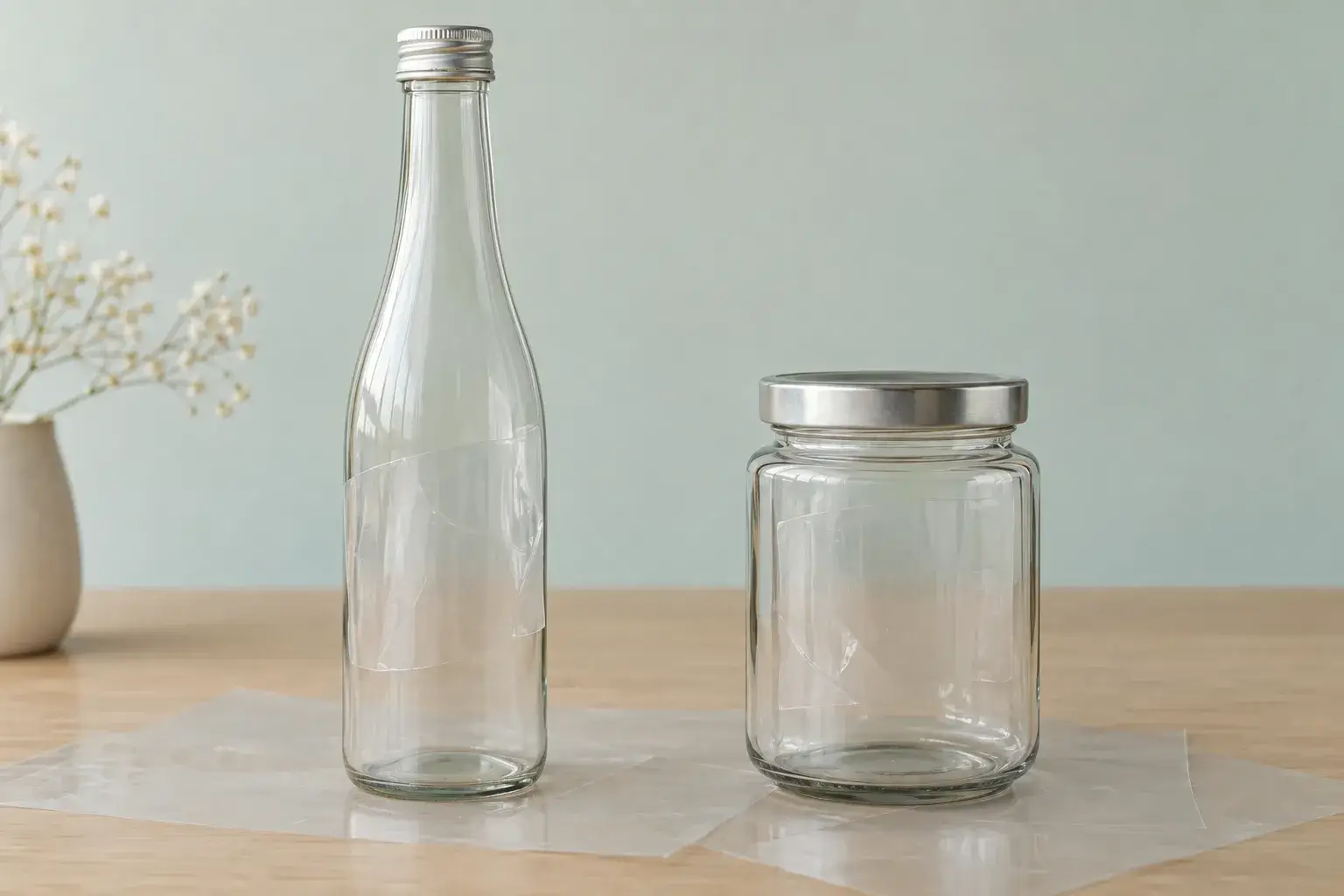
A self-adhesive label consists of three layers: a printed face material, an adhesive, and a backing, the protective sheet removed before application. The term “transparent” refers only to the appearance of the face material, not to a single material.
- Race bib Made of glassine or polyester, it carries the label until it is applied.
- PP polypropylene, used for bottles, vials, cosmetics and food packaging.
- PET and PE polyester and polyethylene, two other transparent plastic face materials.
- PVC polyvinyl chloride, a material distinct from PP despite the frequent confusion between the abbreviations.
On the manufacturing side, Votre Étiquette prints on adhesive materials made in Europe.
Comparing PP, PET and PE
PP is more flexible than PET. Conversely, PET is more rigid and retains its shape better, which is an advantage on a flat surface. PE is better suited to a flexible or slightly deformable container.
The documented thicknesses apply to the face material only: the complete construction, including adhesive and liner, is thicker. PP face materials measure 30, 47, 57 or 185 µm depending on the construction.
| Film | Documented face material thicknesses | Corresponding weights | Intended use |
| PP | 47 µm and 57 µm | 43 and 52 g/m² | Bottles, vials, jars |
| PET | 23, 50, 75, 125 and 180 µm | 32, 70, 105, 175 and 243 g/m² | Rigid surfaces, dimensional stability |
| PE matte | 180 µm | 173 g/m² | Flexible containers, wet applications |
180 µm matte PE is particularly suited to wet applications. This suitability raises the following question: that of the adhesive and the label's actual durability.
Which adhesive and level of durability should you choose based on the intended use?
A good film is not enough. Transparent adhesive labels hold or come loose depending on their adhesive, the temperature at the time of application, and everyday conditions: water, cold, and friction.
Choose the adhesive and application temperature
A permanent adhesive remains on the container. A removable adhesive makes removal easier, without guaranteeing reuse, and prolonged exposure to UV rays may cause it to lose its clean-removal properties. For a transparent, custom self-adhesive label, the minimum application temperature differs from the service temperature: depending on the reference, it is 0, +5 or +10 °C.
The service temperature ranges also vary depending on the construction: from −10 to +100 °C for removable sheets, and from −20 to +80 °C for permanent sheets. Documented permanent rolls cover 0 to +80 °C.
Check water and cold resistance
A water-resistant PP film does not necessarily make the finished label resistant: the adhesive, inks and protective coating are just as important. However, some PP constructions are designed to withstand water, steam and bottle pasteurization.
- "waterproof" label It is not guaranteed for prolonged immersion or dishwasher use.
- Dishwasher : specific PP constructions withstand repeated washing, one from −20 to +100 °C.
- Freezing a standard PP label is not suitable; specialist references are documented for −50, −80 or −196 °C.
- UV Durability depends on the selected material and printing method.
These values describe specific formulations, never PP in general. Therefore, request the data sheet for the actual construction proposed for your custom transparent self-adhesive labels.
Test the application and plan ahead for recycling
In practice, testing three labels allows you to assess application before the production run. For manual application, clean and dry the container, then apply them: the first faces the product after filling, the second cold or condensation, and the third repeated friction. Check them after 24 hours and then after a few days for lifted edges, bubbles, whitening, ink transfer, or peeling. Some peel tests require at least 72 hours after application.
On an oiled, scented, or frequently handled container, the test reproduces these constraints. Recycling also comes into play: according to Citeo, it depends on the combination of the container, face stock, adhesive, and inks. Its matrix dated March 10, 2025 distinguishes, for PET, adhesives that detach during alkaline washing at 60–80°C: an adhesive that is removable in use is not necessarily removable during washing.
How can transparency and readability be maintained?
Once the material and adhesive have been chosen, the visual result is determined during printing. Successful custom transparent labels combine legible text with a subtle effect on the packaging.
Use supporting white in the right place
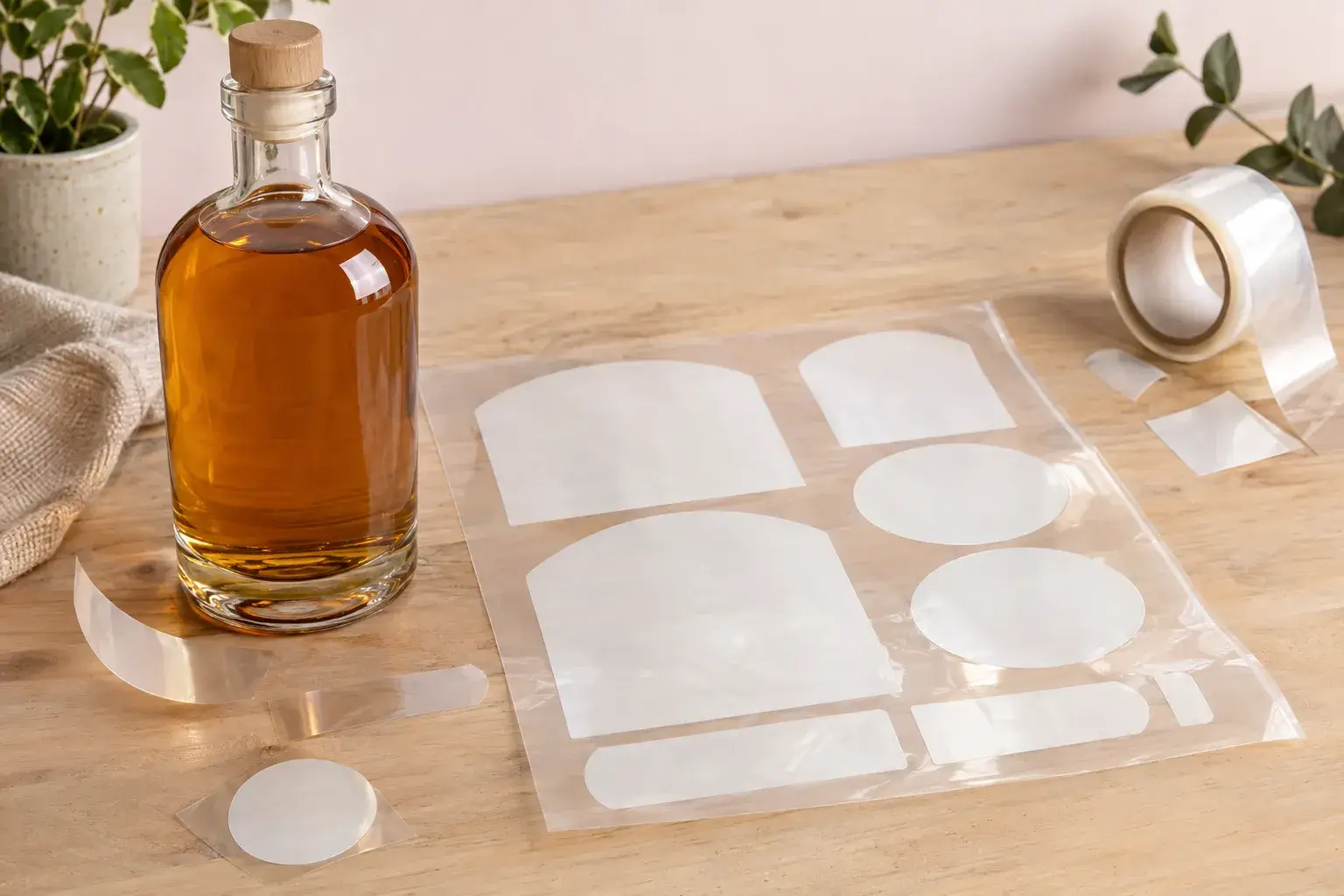
A transparent label creates a “no-label” effect: the design appears to be printed directly onto the container. Without a white underlayer, the inks remain translucent and take on the colour of whatever is behind them.
- Without white Most subtle effect, but colours are influenced by the glass or product.
- Selective white Only certain texts or designs become opaque.
- Pure white enhanced colours across the entire print, at the expense of transparency in the covered area.
Content changes everything. Text that is readable on an empty bottle may lose contrast once it is filled with a dark liquid.
In the file, areas that need to remain transparent must retain a transparent background: a white background would be printed and would erase the desired effect.
Choose a matte or glossy finish
A glossy finish preserves transparency and delivers vibrant colours. It is particularly suitable for a clear glass bottle or jar.
Conversely, a matte finish can create a slightly frosted look and softer colours. It can extend the effect of frosted glass, for example on a candle or cosmetic product.
Depending on the process, a matte or glossy varnish or lamination protects the print from rubbing, grease and cleaning products. Foil stamping, embossing and special inks complete the options.
Preview the result on your product
Votre Étiquette offers an online editor with instant preview: start from a blank page or choose from over 500 designs, then customise the text, fonts, colours, images and logo. Its handmade candle label, a 5 × 5 cm square on glossy PP self-adhesive material, can have its dimensions adjusted during customisation.
The romantic floral wedding design can be printed on the material chosen by the customer. Always compare the preview with the actual container and its contents.
Which formats should you choose, and how should you prepare your order?
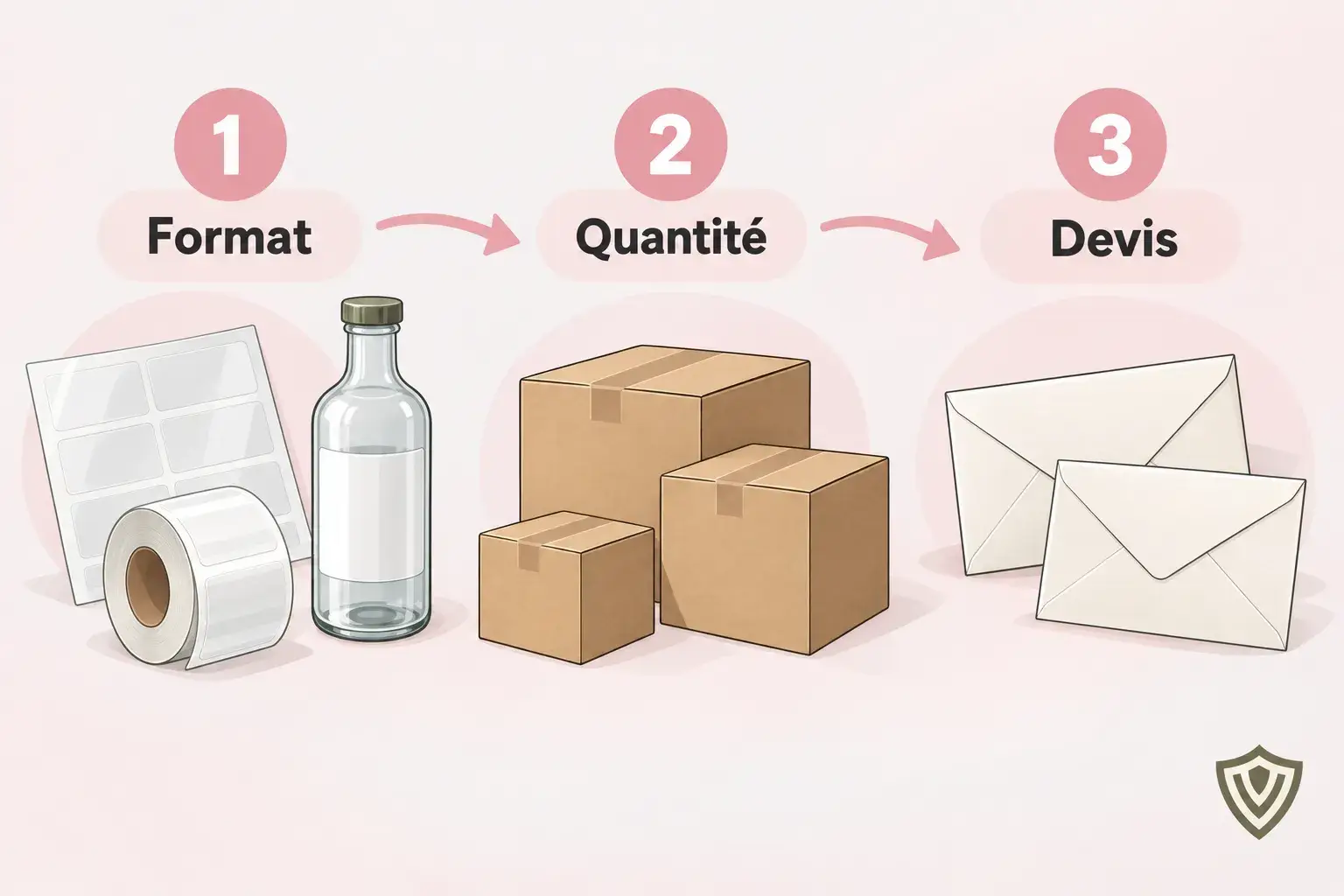
Ordering transparent labels involves selecting the shape, file and packaging. These three choices then directly affect the quote.
Define the shape and cut
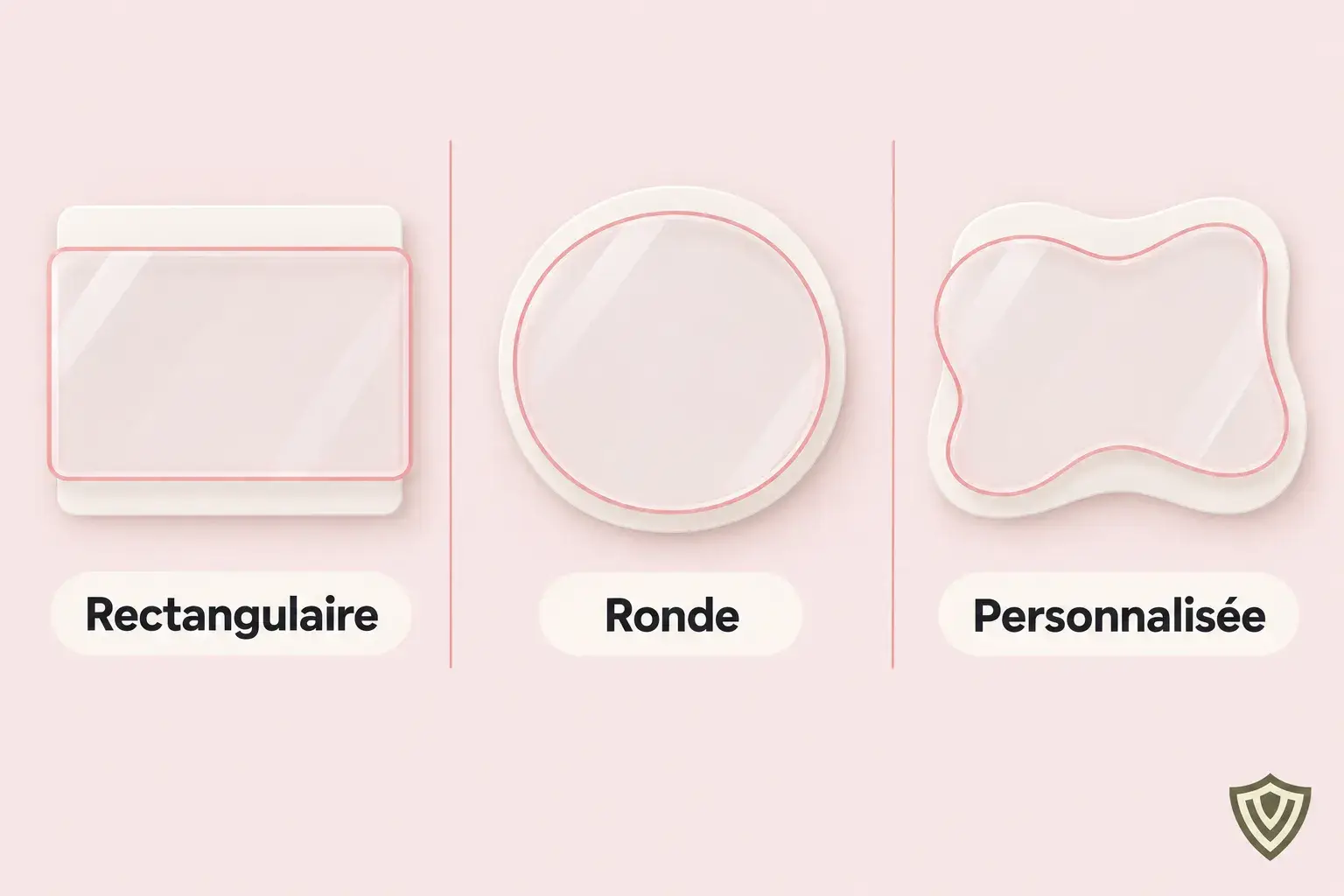
Rectangle, square, round, oval, or custom-shaped label: each shape is suited to a specific application surface. A rectangular transparent label fits neatly around the body of a bottle, while a square label suits the lid of a jar. Votre Étiquette offers custom die-cutting, allowing you to choose the dimensions and shape of your labels while leaving enough room for the design and information.
A contour cut follows the design; some digital processes cut the film without a specific tool, using a closed vector outline. A shape that is too complex may prevent automated weeding, the removal of material around the labels. Published tolerances can be up to ±1 mm or approximately 1 to 2 mm: keep essential elements away from the cut line.
Prepare the file and approve the final result
The file is prepared at actual size. The bleed, an extension of the design beyond the trim line, measures 1.6, 2, or 3 mm depending on the printer. One set of specifications adds a 2 mm safety margin. It also requires 300 dpi for images and 600 dpi for graphic elements, a minimum font size of 7 points, and lines of at least 0.5 points.
The selected printer’s template is authoritative. Prepress checks the CMYK color mode, fonts, die-cut path, and the separate underprint white layer. Before approving the proof (BAT), check the size, orientation, text, and contrast on the actual container; Votre Étiquette offers desktop publishing assistance if needed.
Compare packaging and price
Votre Étiquette lets you order from just 1 item, with volume discounts based on quantity. However, no unit price can be calculated without the complete configuration for printing transparent adhesive labels.
- Sheets suitable for small batches applied by hand.
- Labels on a roll Also suitable for automatic application if the core, spacing, orientation and winding direction match the machine.
- Individual transparent stickers to distribute at an event.
- Quote settings material, adhesive, dimensions, cut, finish, white, packaging and number of designs.
For large quantities, roll format can reduce the unit cost, though there is no universal threshold. Increasing the number of custom self-adhesive labels is of little use if the product references change frequently. In mainland France, where VAT is charged at the standard rate of 20%, comparing quotes on the same basis, either excluding or including tax, helps avoid confusing prices.
What information must the label be able to include?
The chosen format must leave room for the legal information. For food products, candles or household packaging, labelling has its own requirements in terms of surface area and readability.
Reserve space for food information
According to the DGCCRF, a prepackaged food product may be required to display several pieces of information depending on the product. They must remain visible, legible, and at least in French.
- Product identity product name and net quantity.
- Composition Ingredients and allergens.
- Storage and responsibility appropriate date and responsible operator.
- Character size : an “x” height of at least 1.2 mm in accordance with Article 13 of Regulation (EU) No 1169/2011, or 0.9 mm if the largest surface area is less than 80 cm².
An adhesive label affixed to the outside of a jar is not presumed suitable for direct contact with food. If such contact is intended, compliance applies to the construction actually used; the DGCCRF recalls the framework of Regulation (EC) No 1935/2004 and the good manufacturing practices set out in Regulation (EC) No 2023/2006.
Check origin information
According to the DGCCRF, origin is mandatory for virgin and extra virgin olive oils. A local or regional origin remains reserved in particular for oils covered by a PDO or PGI.
For honey blends, Directive (EU) 2024/1438 of 14 May 2024 requires the countries of origin to be listed in descending order by weight, together with their percentages.
In France, Decree No. 2026-312 of 24 April 2026 applies these rules to products placed on the market from 14 June 2026; compliant existing stocks may be sold until they are exhausted. The printer's file check does not replace the regulatory verification, which remains the operator's responsibility.
Include the candle and recycling information
Depending on its formulation, a scented candle may be subject to hazardous chemical product labelling: INERIS addresses its classification, UFI and notification to poison control centres. This information remains legible, even on small personalised transparent labels. Regulation (EU) 2024/2865, as amended by Regulation (EU) 2025/2439 of 26 November 2025, sets separate deadlines in 2026, 2027 and 2028.
For the household packaging concerned, Citeo states that the Info-tri label has been mandatory since 1 January 2022, with the Triman logo accompanied by sorting instructions. Regulation (EU) 2025/40, generally applicable from 12 August 2026, provides for harmonised material labelling by 12 August 2028 at the latest, subject to its implementing acts.