Custom Candle and Perfume Label: Create Your Own
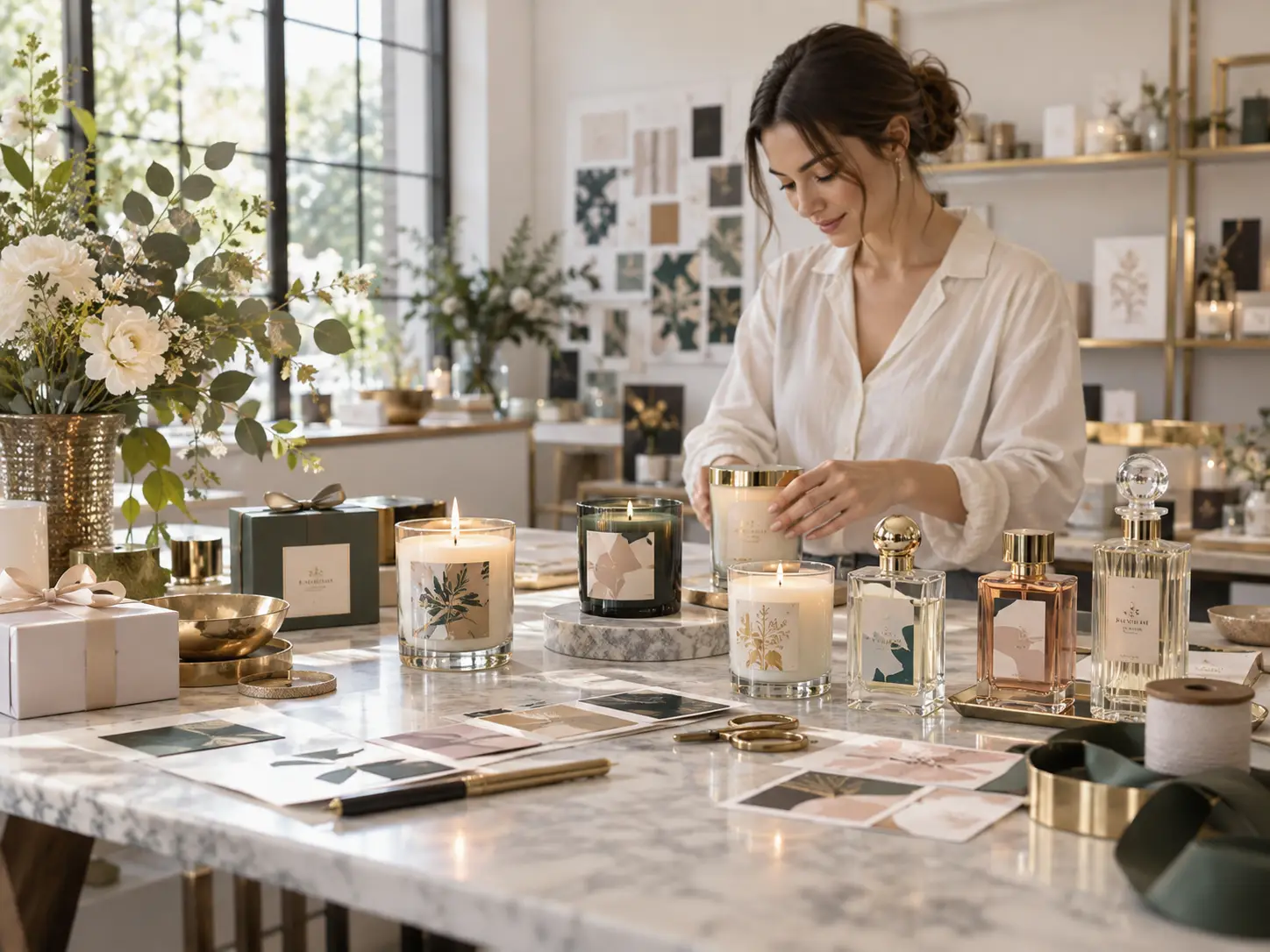
A custom label for a candle or perfume bottle must fit the container, remain legible, and stand the test of time. The format, design, material, adhesive, print file, and the information required for each product category are all decided together before printing.
What label size should you choose for a candle or a fragrance?
No single size works for every candle or fragrance. The format depends on three factors: the available surface area on the container, its curvature, and the amount of text to be printed. Measuring first avoids having to redesign later.
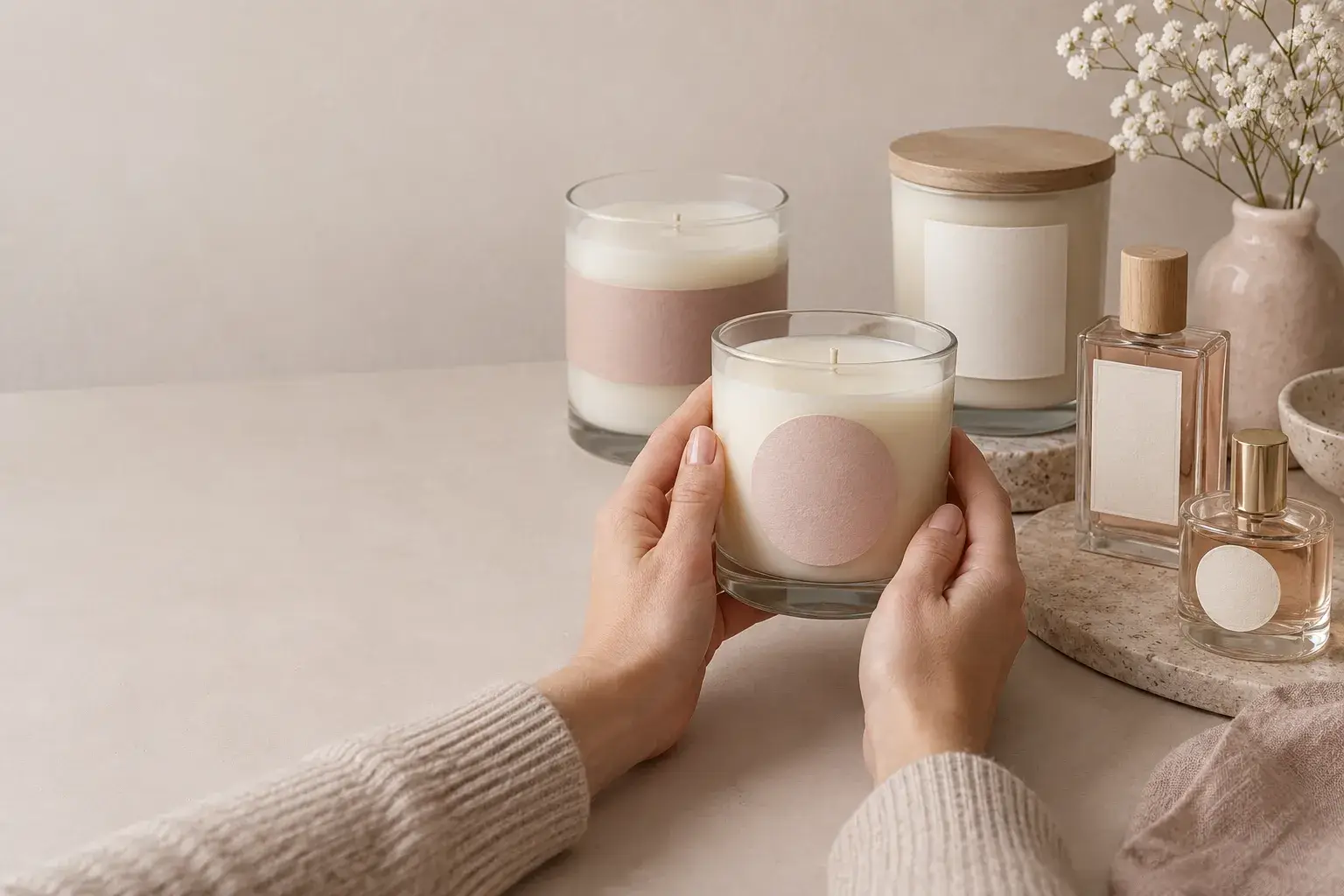
Adapt the shape to the available surface
Each shape is suited to a particular space. A round label can be placed on a lid or on a small personalised candle to give as a gift at an event. Conversely, a rectangular label provides several lines of information on the side of a jar.
For a 300 ml jar, the guidelines below provide a starting point. These sizes are for reference only: no standard requires them.
| Shape | Indicative dimensions for a 300 ml jar | Type location |
| Round | 70 mm in diameter | Lid or front of the jar |
| Square | 70 × 70 mm | Front of the jar |
| Rectangular | 100 × 60 mm | Wall, multiple lines of text |
| Wraparound | 250 × 50 mm | Full circumference of the jar |
Whether you choose round formats or other shapes, the final size should be selected based on the actual application area measured on your containers, not on the jar’s volume.
Measure a straight-sided or tapered jar
On a cylindrical container, wrap the application area with a flexible tape or strip of paper. Mark the desired coverage, then measure the usable length and height. For example, a cylinder with an outer diameter of 70 mm has a theoretical circumference of approximately 219.9 mm. With a chosen clearance of 3 mm, the starting length is 216.9 mm, to be confirmed with a test.
A conical jar requires greater precision. Its diameter changes with height: the length of a wraparound label must therefore be calculated at the exact application height, never based solely on the maximum diameter.
Locate the bottle edges
Lid edges, shoulders, contours and grip areas reduce the usable surface area. On a rectangular bottle, the width and height of the flat side determine the front label format; a back label can accommodate detailed information. On a small curved bottle, a full-size paper template can be tested on the filled and closed container: if it is too wide, the label wrinkles or lifts at the edges.
How can you customize a readable design?
Once the format has been finalized, the design must fit within it without losing readability. The elements will not be the same for an event gift and for a range sold in-store: the message takes precedence in one case, while the hierarchy of information does in the other.
Create a personalized candle for an event
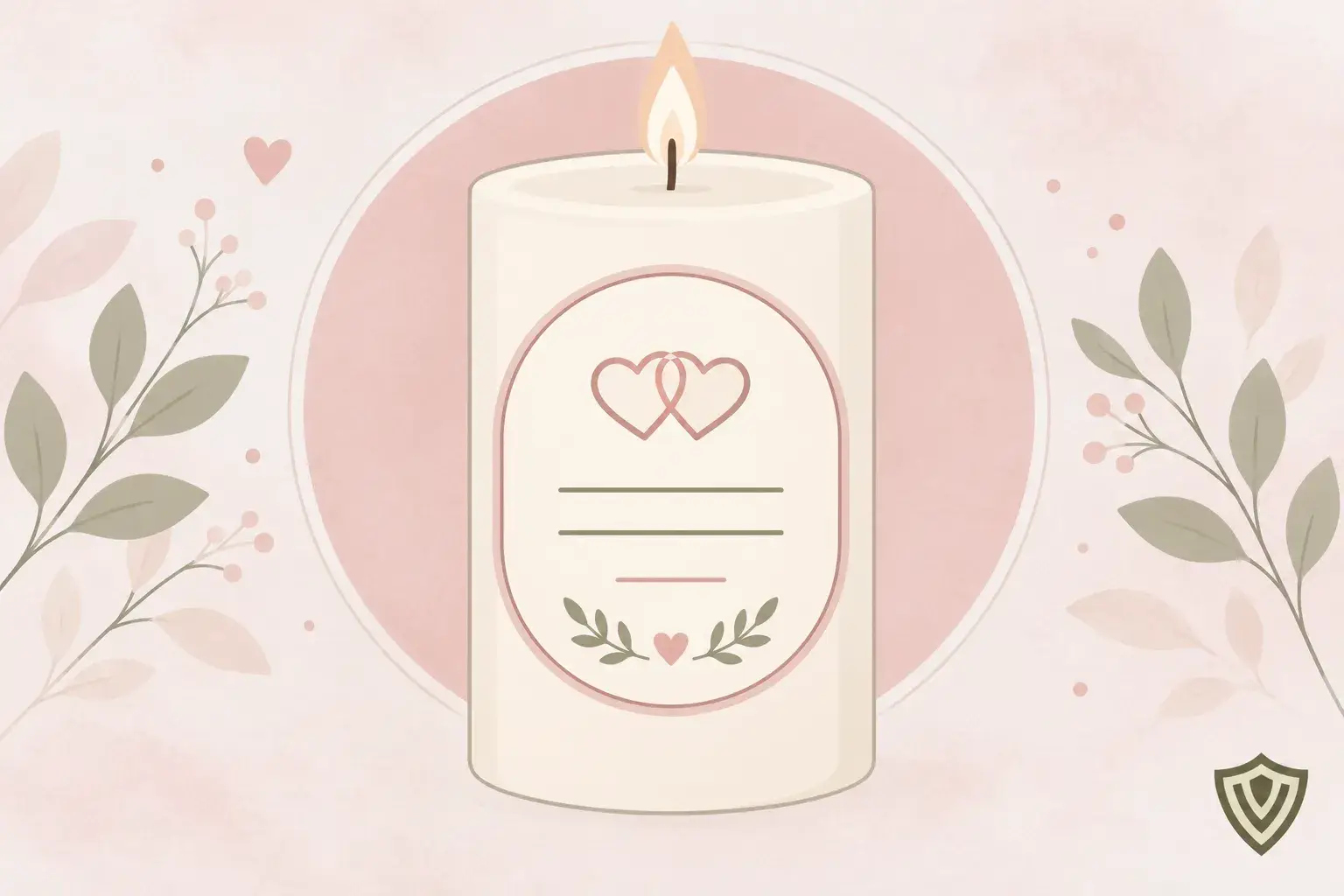
For a wedding, a personalized candle label given to guests can feature the couple's first names, the date, and a brief thank-you message. Everything reflects the ceremony's visual identity: the same colors and patterns.
Other occasions call for suitable text and designs:
- Birthday the first name, the age being celebrated, or a short message.
- Baptism : the child’s first name, the date, and a floral design or a simple illustration.
- Holiday season a colorful and festive creation, perfect for a whole range of gifts.
A ribbon or dried flowers are a lovely complement to a personalised candle given as a gift. They enhance the gift without replacing the information printed on the label.
Prioritize the information in a product range
A candle brand can include its logo, the fragrance name, the type of wax, the weight and an estimated burn time in hours. This burn time varies depending on the wax, the size of the candle and the choices made during candle making. Visually distinguishing the brand, fragrance and nature of the product guides the eye, while using too many decorative fonts makes it harder to read.
Four-colour printing, which combines four inks to reproduce every shade, renders text, logos and images. Votre Étiquette offers in its range of personalized labels for candles minimalist templates, refined designs for premium ranges, and festive creations, suitable for floral fragrances as well as other worlds.
Create and check the result in the editor
Designing a label in the Votre Étiquette editor gives you the choice of editing text, colours, typography, backgrounds, icons, images and logos, or importing your own visual identity. An AI assistant can also generate a candle label proposal based on your instructions.
The editor works in a browser, with no installation required, and displays each change immediately. This on-screen customization does not replace a full-size check: on a small label, a first name, a date, or a fine pattern may become difficult to read.
Which materials should you choose, and how can you ensure they stay in place?
A successful design also depends on the material that carries it. The difference lies in the chosen substrate: paper or film, finish, and adhesive, each selected according to the container’s actual use.
Choose paper or film according to the intended use
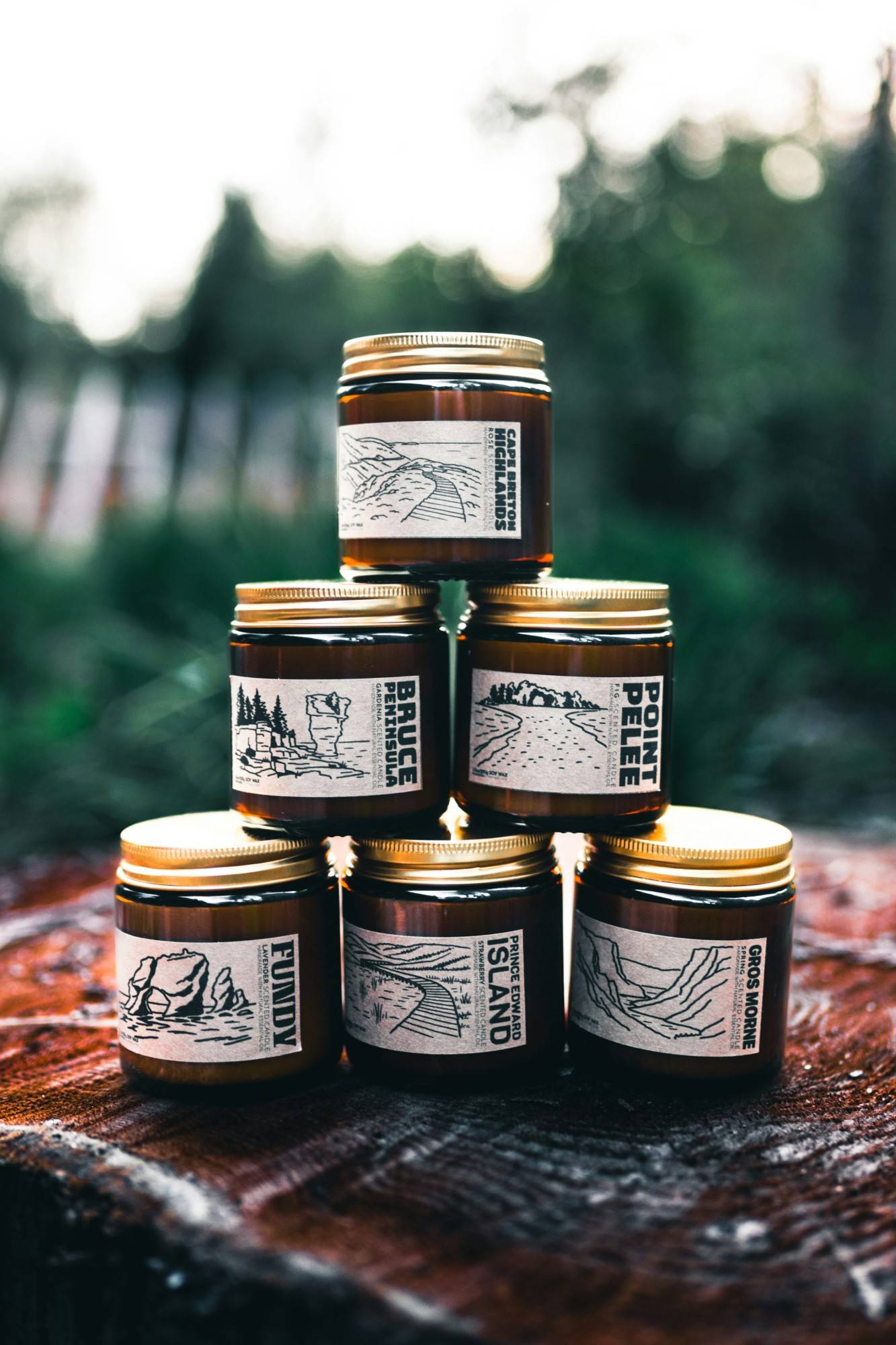
Matte or textured paper is suitable for a handcrafted presentation, on a container that stays dry and is subject to little friction. Brown kraft paper gives candle jars a natural or rustic appearance.
As soon as the bottle is exposed to moisture, handling or splashes, a synthetic film should be considered; its durability also depends on the ink, finish and adhesive. A transparent label allows the glass and its contents to show through. Then check the contrast on the actual container: a backing white, printed beneath the colours, may be necessary to keep them opaque.
Match the finish and adhesive to the product
For custom perfume bottle labels, Votre Étiquette offers textured paper, transparent materials, hot foil stamping, embossing, and spot varnish. These finishes change the appearance or feel and may require a specific technical file.
For candles, Votre Étiquette prints on materials resistant to heat, abrasion and moisture. However, moisture resistance does not prove heat resistance, and a permanent adhesive is not enough: for a candle label, both the material and adhesive must be tested under the intended conditions of use. The same requirements apply to other materials and situations: cold or condensation-covered glass, pronounced curvature, textured surfaces, and splashes of alcohol-based fragrance.
Apply and then check the label
First clean the container to remove dust, grease and residue, then allow it to dry. For a series, use a positioning mark to maintain the same height and orientation. Attach one part of the label, then smooth it gradually towards the sides to minimise bubbles and wrinkles. Stretching it to fit a curve compromises adhesion.
After the adhesive's specified curing time, check alignment, bubbles, legibility and edges. Durability should then be tested on the final container, after the intended storage and handling. For a candle, areas exposed to heat should be checked under representative conditions of use, without improvised testing that could cause a fire.
Create your own labels or have them printed?
You have two options: print your labels on suitable sheets or have a professional print the design. The choice depends on the desired quantity, material, and finish.
Compare the two printing methods
Printing at home requires sheets compatible with the printer, whether inkjet or laser, and with the selected format. Professional printing takes over based on several criteria:
- Material film, textured paper or transparent materials often exceed home printing capabilities.
- Finish Foil stamping, embossing or spot varnishing require a specific process.
- Quantity and presentation a series supplied on a roll is not well suited to home printing.
At home, the domestic route is mainly suitable for trials and small batches. Votre Étiquette prints custom labels starting from just 1 copy, with volume discounts as quantities increase.
A customizable graphic template is used to prepare a design: it does not, on its own, constitute a physical label. If your design already exists, the Votre Étiquette editor allows you to import it as is.
Prepare a print-ready file
The file follows the template for the selected process, and Votre Étiquette recommends importing a PDF for print quality. Let's take theround label for scented candle on matte paper: final size 35 × 35 mm. With at least 1 mm of bleed on each side, the file measures 37 × 37 mm. The material and dimensions can still be modified in the editor.
Bleed extends the image beyond the trim line to prevent a white border. For a candle label printed with photos, 300 pixels per inch at final size is a common guideline for raster images. The CMYK profile, font embedding, and any cut path should follow the production guidelines.
Approve the proof and estimate the cost
The proof, i.e. the version approved before production, is checked at actual size on the final container. Reflections from the glass and the colour of the wax or liquid affect the legibility perceived on screen.
To compare orders, set the dimensions, quantity, material, adhesive, finish and available file. Graphic preparation, corrections, sample, special finishing or roll production affect both the cost and the timeline.
What information should be included depending on the product?
A name, a logo or a scent are not always enough. Candles, home fragrances and cosmetic fragrances are subject to different regulations, which must be considered from the design stage to allow the necessary space on the label.
Distinguishing between candle safety and CLP
A decorative label does not replace safety information. Two texts, serving different purposes, accompany a candle label, and the relevant standard or regulation does not replace the other:
- The NF EN 15494 standard Published in November 2019 in accordance with AFNOR, it replaced the December 2007 edition and addresses the combustion safety of indoor candles; it does not, on its own, constitute a legal requirement that applies identically to all candles.
- Real security It depends on the composition, the wicks, the containers, and the intended use, not on the shape of the label.
- CLP Regulation (EC) No 1272/2008 It requires examining the composition and classification of the finished scented candle; the label of the fragrance concentrate must not be copied.
- Allergy risk According to ECHA guidance, a statement may be required even if the final mixture is not classified as a sensitizer.
Depending on the classification, the CLP label may include the product identifier, supplier details, pictograms, and hazard or precautionary statements. For packaging of no more than 0.5 litres, the regulation provides for a minimum format of 52 × 74 mm “where possible”. The relevant pictograms must measure at least 10 × 10 mm, subject to the applicable rules.
Explore each home fragrance
A reed diffuser and a room spray each require their blend and packaging to be assessed. They do not automatically use the same label as a candle with the same fragrance. For the relevant mixtures, check the notification to poison control centres and the UFI, the unique formula identifier: the one for the concentrate is not automatically the one for the finished product.
According to ECHA, a UFI refers to a specific composition; changing the formula may require the identifier and associated information to be reviewed. Regulation (EU) 2024/2865, which revises the CLP, applies in stages from 1 July 2026 and 1 January 2027. A final deadline follows on 1 January 2028: check the requirement in force on the date of placing on the market.
Include the required cosmetic fragrance information
A fragrance applied to the skin falls under the Cosmetics Regulation (EC) No 1223/2009, not CLP labelling. Article 19 requires, among other things, the responsible person and their address, the nominal content except in certain cases, the date of minimum durability or period after opening, precautions, the batch number, the function where necessary, and the list of ingredients.
In this list, the fragrance composition is indicated under the term “parfum”, together with the substances that must be declared. The information must be visible, legible and indelible; some may appear on the outer packaging under the applicable conditions. Before sale, also check the safety assessment, the product information file and the CPNP notification, as these are not covered by technical validation of the print file.